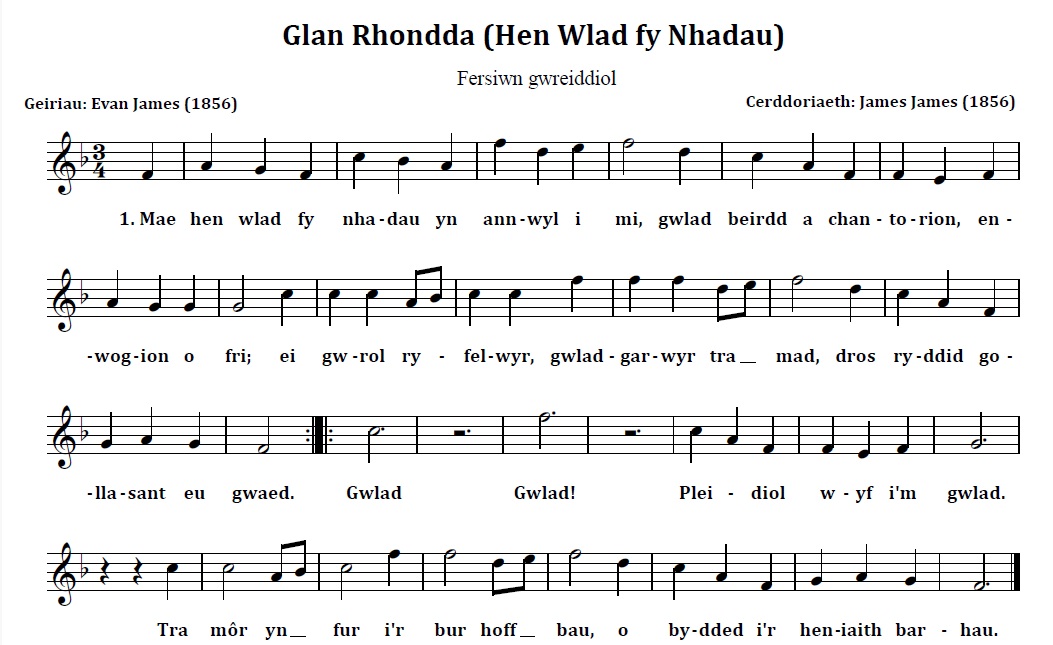
'Hen Wlad fy Nhadau' (The Land of my Fathers) is the national anthem of Wales. The words were written in 1856 by Evan James and the tune composed by his son James James. It was originally called 'Glan Rhondda', because that was where it was composed, but was quickly renamed as it gained popularity. Here is the original melody with the first verse and chorus.
Lyrics
Here are the words with a literal translation.
1. Mae hen wlad fy nhadau yn annwyl i mi,	The old land of my fathers is dear to me,
Gwlad beirdd a chantorion, enwogion o fri;	Land of bards and singers, famous men of renown;
Ei gwrol ryfelwyr, gwladgarwyr tra mad,		Her brave warriors, very splendid patriots,
Dros ryddid gollasant eu gwaed.			For freedom shed their blood.

	Gwlad, Gwlad, pleidiol wyf i'm gwlad,	Country, Country, I am faithful to my Country.
	Tra môr yn fur i'r bur hoff bau,	While sea is a wall to the pure beloved land,
	O bydded i'r heniaith barhau.		O may the old language endure.

2. Hen Gymru fynyddig, paradwys y bardd;	Old mountainous Wales, paradise of the bard,
Pob dyffryn, pob clogwyn, i'm golwg sydd hardd	Every valley, every cliff, to my look is beautiful.
Trwy deimlad gwladgarol, mor swynol yw si	Through patriotic feeling, so charming is the murmur
Ei nentydd, afonydd, i fi.			Of her brooks, rivers, to me.

3. Os treisiodd y gelyn fy ngwlad dan ei droed,	If the enemy oppressed my land under his foot,
Mae hen iaith y Cymry mor fyw ag erioed,	The old language of the Welsh is as alive as ever.
Ni luddiwyd yr awen gan erchyll law brad,	The muse is not hindered by the hideous hand of treason,
Na thelyn berseiniol fy ngwlad.			Nor the melodious harp of my country.
In Verse 1, mad is now often written as "mâd", though this does not appear in any dictionary I've checked, and "dros" as "tros". In the chorus, "heniaith" is often written as "hen iaith". The second and third verses are not often sung.
'Blue Marble Nations', a site with many national anthems, has the first verse with an orchestral accompaniment.
Only Men Aloud, the Wales team and their supporters proudly & loudly sing 'Hen Wlad Fy Nhadau', the Welsh national anthem in Round 3 of the RBS 6 Nations as France take on Wales at Stade de France, Paris 2015.
Bryn Terfel leads the singing of all three verses.
Notes for Welsh learners
"Hen wlad fy nhadau" translates as "The old land of my fathers" rather than just "Old land of my fathers", in the same way as "hen wlad y tadau" would translate as "the old land of the fathers".
"Enwogion" is the plural form of the adjective "enwog" (famous), also used as a noun to mean "famous people".
"Collasant" is the literary third-person plural 'preterite' of colli (to lose). The 'preterite' tense is otherwise known as the past perfect, when something has a definite beginning and end, equivalent to "dw i wedi, rwyt ti wedi" etc. The literary endings are: -ais, -aist, -odd, -asom, -asoch, -asant; the equivalent spoken ones are: -es i, -est ti, -odd o / e / hi, -on ni, -och chi, -on nhw.
"Bydded" is the literary third-person singular imperative of bod, i.e. "let it be", and is followed with the preposition "i" before the noun.
"I'm" is the same as "I fy" (to my), used in literary Welsh.
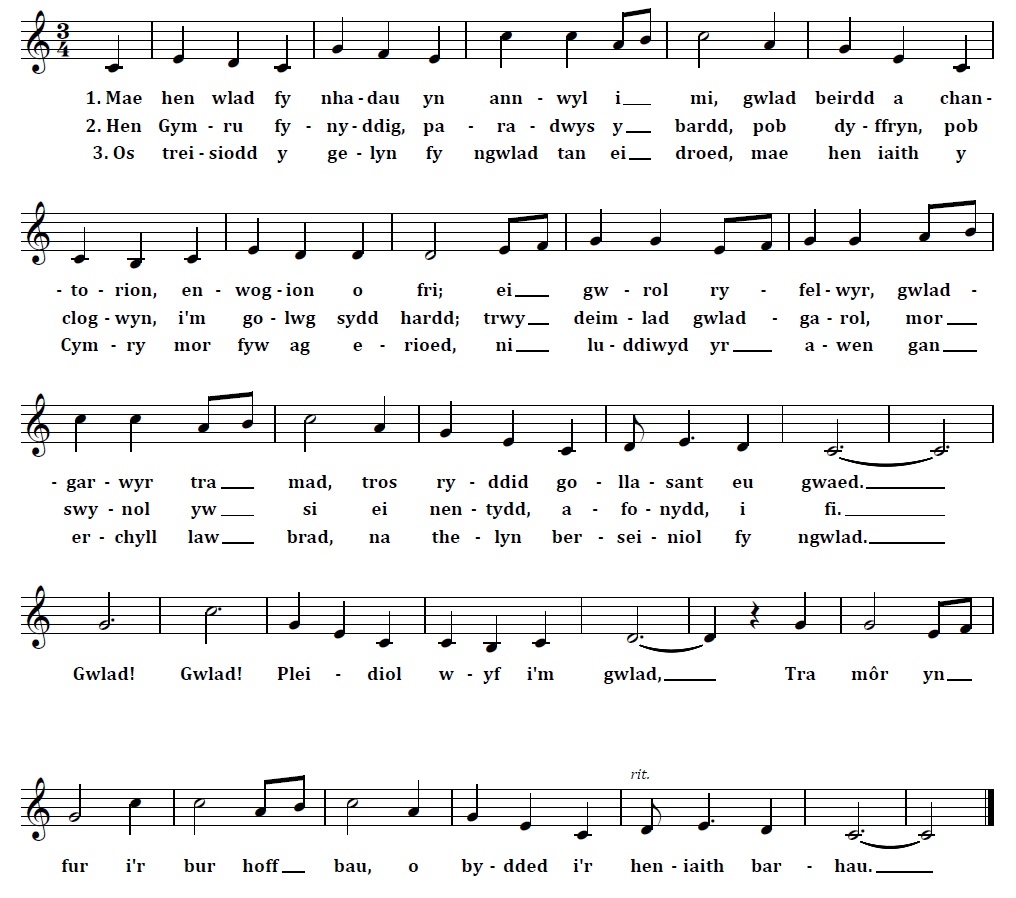
Finally, here is a version with some modifications to the rhythm which are generally adopted nowadays, and all three verses against the notes to show how the words fit. I've also adjusted the key to C so that I can reach the top notes! The original was designed to be sung by a soprano.